
CES 2026 reflected a change in emphasis in how NVIDIA presented its technology portfolio. Rather than centering the week on product launches or benchmark disclosures, the company used the show to demonstrate how its computing systems, software frameworks, and partner integrations are being applied across real-world environments. The focus was less on individual components and more on how AI infrastructure, simulation, and reasoning models are being combined to support physical systems, from factories and vehicles to robots and medical devices.
Across keynotes, partner demonstrations, and technical briefings, NVIDIA emphasized development workflows, system architecture, and deployment context. CES was used to show how AI systems are being designed, trained, and evaluated ahead of broader adoption.

Above: a photo of the NVIDIA Rubin GPU on a video display at CES 2026 Fontainebleau Las Vegas. Photo by David Aughinbaugh II for CircuitRoute.
From Components to Integrated AI Systems
At the infrastructure level, NVIDIA’s CES messaging emphasized computing systems rather than individual GPUs or accelerators. The company consistently described compute as part of larger, tightly integrated systems designed to address data movement, power constraints, and memory demands associated with modern AI workloads.
That direction was most clearly illustrated through references to the Vera Rubin NVL72 rack-scale system, which NVIDIA described as a unified AI supercomputer rather than a collection of discrete parts. While the underlying architecture had already had already been detailed elsewhere, its presence at CES reinforced how NVIDIA views large-scale AI deployment: as a system-level challenge involving compute, networking, and orchestration rather than raw throughout alone. Importantly, Rubin was discussed in architectural terms, not as a finalized deployment offering, and NVIDIA did not introduce new benchmark data or customer adoption figures during the event.

Above NVIDIA AI Supercomputing Rack NVL72 (Likely Grace Blackwell and not Vera Rubin) on Display at CES 2026. Photo by David Aughinbaugh II for CircuitRoute.
Software, Simulation, and the Physical AI Stack
Much of NVIDIA’s CES narrative centered on software, particularly the role of simulation and reasoning models in developing AI systems that interact with the physical world. The company consistently used the term “Physical AI” to describe this category, defining it as AI designed to perceive, reason about, and operate within real-world environments governed by physical constraints.
Within that framework, NVIDIA highlighted a layered software stack spanning digital twins, simulation, and model training. Omniverse and OpenUSD were repeatedly referenced as foundational tools for building and synchronizing digital representatives of physical systems, especially in industrial and robotics contexts. PhysicsNeMo was positioned as a way to introduce physics-aware generative modeling into simulation workflows, enabling developers to explore scenarios that are difficult to evaluate directly in real-world environments.
On the model side, NVIDIA pointed to its Nemotron reasoning models and Cosmos world foundation models as core components for training AI systems capable of more complex decision-making. IN robotics, Isaac GR00T was presented as a reasoning framework intended to support embodied intelligence rather than task-specific automation. Across these disclosures, NVIDIA emphasized composability and extensibility, describing these tools as building blocks rather than turnkey solutions.
Agents and Local Reasoning Demonstrations
One of the more illustrative demonstrations at CES involved AI agents running locally rather than relying on cloud-based inference. NVIDIA used DGX Spark to show how reasoning models, perception pipelines, and speech systems could be combined into a locally executed agent that interacts with the physical world through a robotic endpoint.
This demonstration, which incorporated open NVIDIA models and a small robotic platform, was framed explicitly as a reference workflow illustrating how existing components can be composed together, not as the announcement of a new commercial agent platform. NVIDIA did not present it as a consumer product or a finished robotics system. Instead, the goal was to show how private, on device execution could support agent-based AI development without reliance on cloud-based inference. In the broader CES context, this example served to connect NVIDIA’s work on models, simulation, and hardware into a single, coherent development narrative.

Above: Photo of the NVIDIA DGX Spark GB10 Grace Blackwell models from NVIDIA, Acer, ASUS, Dell, GIGABYTE, HP, Lenovo, and MSI on display at CES 2026 Fontainebleau Las Vegas. Photo by David Aughinbaugh II for CircuitRoute.
Industrial and Infrastructure Partnerships
Those same development principles, simulation-first design, closed-loop evaluation, and system-level integration appeared across NVIDIA’s industrial partnerships at CES. Industrial use cases featured prominently through collaborations with Siemens, Caterpillar, and Hitachi, with NVIDIA positioned as a provider of computational and simulation foundations rather than an operator of deployed systems.
With Siemens, the companies described an expanded collaboration around what they referred to as an Industrial AI Operating System. Rather than a traditional operating system, this concept was presented as a collection of AI-enabled workflows, simulation tools, and infrastructure designed to support factory design, operation, and optimization. Siemens outlined plans to apply these tools within select manufacturing environments, while NVIDIA positioned its contribution around AI infrastructure, Omniverse-based digital twins, and accelerated computing libraries. Neither company disclosed deployment timelines beyond early pilot environments, nor did they provide quantified performance outcomes.
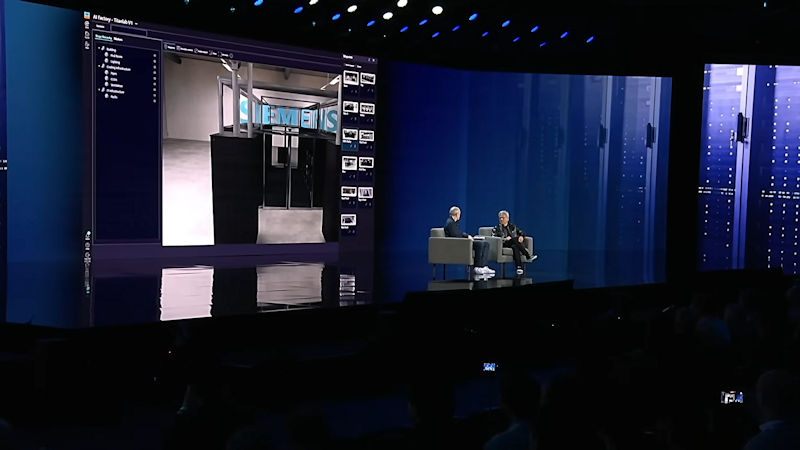
Above photo of the Siemens NVIDIA keynote at CES 2026. Roland Busch, CEO Siemens, and Jensen Huang, CEO NVIDIA, both discussed Digital Twins and how the companies are working together. Photo from the Siemens Keynote video on YouTube. Used under the fair use provision.
Caterpillar’s CES presence focused on applying AI at the edge, particularly in construction and heavy equipment. NVIDIA technologies were shown supporting real-time inference on machinery, factory-level simulation, and internal workforce tools. The emphasis remained on development and evaluation, with Caterpillar retaining ownership over deployment decisions and operational rollout.
Hitachi presented a similar approach within the context of social infrastructure, highlighting AI-enabled modeling and optimization across energy, transportation, and industrial systems. NVIDIA was positioned as a technology partner supporting simulation and analysis, while Hitachi emphasized ecosystem collaboration rather than near-term commercialization.
Automotive and Autonomous Mobility
Automotive announcements at CES followed a consistent pattern: NVIDIA provided the computing and software foundation, while vehicle manufacturers and mobility companies retained responsibility for system integration and deployment.
In advanced driver assistance, NVIDIA and Mercedes-Benz highlighted MB.DRIVE ASSIST PRO, a navigation-integrated driver assistance system classified as SAE Level 2, which Mercedes-Benz plans to introduce beginning with the CLA platform. NVIDIA’s contribution centered on DRIVE AGX hardware and the DRIVE AV software stack, while Mercedes-Benz made clear that the system does not represent autonomous driving. Availability details varied by region, with China deployments confirmed and U.S. launches planned, but no changes to autonomy classification were announced.
In autonomous mobility, Lucid, Nuro, and Uber jointly unveiled a next-generation robotaxi concept at CES. Built on the Lucid Gravity platform and using Nuro’s Level 4 autonomous system, the vehicle integrates NVIDIA DRIVE AGX Thor for compute. Public statements confirmed ongoing testing and production intent, but NVIDIA did not claim ownership of the autonomy stack or operational deployment.
Robotics and Embodied AI Ecosystem
Robotics demonstrations at CES were grouped under NVIDIA’s broader Physical AI theme rather than treated as individual product launches. Multiple partners showcased systems built on NVIDIA compute and software, including AGIBOT humanoid platforms using Jetson Thor, Franka Robotics research manipulators leveraging Isaac GR00T, and LEM Surgical’s clinically deployed robotic system for healthcare applications.
Across these examples, NVIDIA consistently positioned itself as an enabling technology provider. Compute platforms, simulation environments, and AI models were presented as tools partners could adapt to their specific domains. NVIDIA avoided claims of autonomous operation, instead emphasizing supervised systems, training workflows, and evaluation environments.
Consumer and Gaming
Alongside its enterprise and industrial focus, NVIDIA also announced updates within its consumer ecosystem, including enhancements to DLSS, new G-SYNC display technologies, and expanded availability for GeForce NOW. These announcements were presented as incremental ecosystem updates rather than central themes of the company’s CES presence.

Above photo of the NVIDIA GeForce RTX 50 Series Graphics Cards at CES 2026 Fontainebleau Las Vegas. Photo by David Aughinbaugh II for CircuitRoute.
Jensen Huang’s CES 2026 Appearances
NVIDIA President and CEO Jensen Huang appeared across multiple CES sessions, including NVIDIA-hosted presentations and partner events. His remarks focused on the evolution of AI systems toward reasoning-driven, physically grounded applications. He did not introduce financial guidance, benchmark results, or deployment commitments, instead using CES to contextualize longer-term architectural direction.

Above: a photo of the Lenovo Tech World Keynote at the Sphere Las Vegas CES 2026 featuring NVIDIA and Jensen Huang. Photo by David Aughinbaugh II for CircuitRoute.
CES 2026 in Context
CES 2026 clarified how NVIDIA’s technologies are being assembled into systems intended for physical environments, spanning AI infrastructure, simulation platforms, and partner-led integration across industry, mobility, and robotics. At the same time, NVIDIA stopped short of validating those systems in production settings. The company did not disclose standardized benchmarks, large-scale customer deployments, regulatory approvals, or timelines for mass adoption, and it avoided making autonomy or performance guarantees.
Instead, the event emphasized development workflows, simulation-driven design, and architectural direction, with deployment responsibility and operational outcomes left to partners. Whether these approaches result in durable, large-scale deployments will depend on execution beyond the CES show floor.